

304 vs 316 vs 2205 Duplex Stainless Steel: Which Grade Should You Specify for Coastal Projects?
If your installation sits within a few hundred metres of salt water, the grade you specify decides whether the hardware still performs in year ten. The short answer: 304 is an inland grade, 316 handles urban and sheltered coastal conditions, and 2205 duplex is the one that survives the splash and spray zone.
The Short Answer
|
|
304 |
316 / 316L |
2205 duplex |
|
Common designations |
UNS S30400, EN 1.4301 |
UNS S31600 / S31603, EN 1.4401 / 1.4404 |
UNS S32205 (S31803), EN 1.4462 |
|
Molybdenum |
None |
2–3 % |
3.0–3.5 % |
|
Nitrogen |
~0.1 % |
~0.1 % |
0.14–0.20 % |
|
PREN |
≈ 18 |
≈ 24 |
≈ 34 |
|
Min. 0.2 % proof stress |
— |
— |
450 N/mm² |
|
Salt water / splash zone |
Not suitable |
Marginal to poor |
Designed for it |
|
Where it earns its place |
Inland balustrades, dry indoor fittings |
Urban and sheltered coastal facades |
Splash-zone pool fences, marine and boat hardware, seawater pumps and valves |
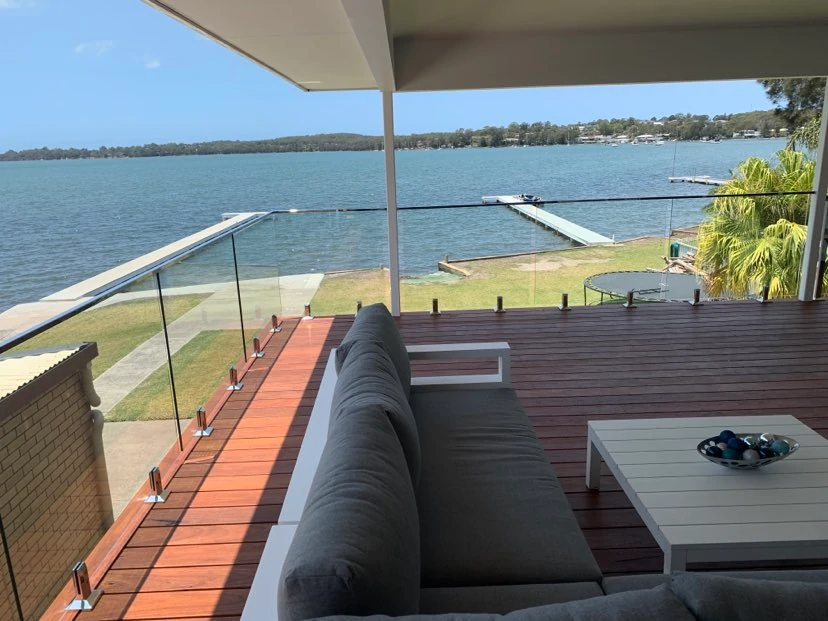
Why Coastal Hardware Fails
Stainless steel fails on the coast because chloride ions break down the passive chromium-oxide layer, and they concentrate in the worst places: the crevice between glass and gasket, the joint under a base plate, the thread of a fixing.
Three failure modes matter: pitting (localised breakdown that reaches the core of the part), crevice corrosion (the same mechanism, accelerated where oxygen cannot refresh — exactly where glass clamps live), and chloride stress corrosion cracking (cracking under sustained tensile stress, the weakness of austenitic 304 and 316).
Molybdenum counts 3.3 times chromium and nitrogen 16 times, which is why 2205 moves so far with small additions. A PREN above about 32 is generally taken as the seawater threshold — 316 sits well below it.
One caveat: PREN predicts relative resistance, it does not guarantee a finished part. Surface finish, crevices, weld quality and the real chloride level all change the outcome, and published “salt spray hours” are rarely comparable between suppliers — ask for the test standard and the pass/fail criterion.
304: Right for Inland
304 is the workhorse grade and it is correct more often than premium-minded specifiers admit: indoors, in freshwater and in dry architectural work its chromium level is plenty, and it is the easiest of the three to form and weld. It becomes the wrong choice as soon as chlorides appear regularly — sea spray, chlorinated pool water and de-icing salts show up first as tea-staining, then as pitting.
316 / 316L: Capable, with a Ceiling
Molybdenum lifts the PREN from about 18 to about 24, making 316 a capable grade for urban, industrial and sheltered coastal conditions, with far more fabrication tolerance than duplex. Its ceiling is the splash zone: practitioner experience is consistent that 316L is marginal in cold climates and should not be relied on in temperate ones. Where a coastal 316 installation fails, it almost always fails at a crevice, not on an exposed surface.
2205 Duplex: Built for This Job
2205 is a two-phase (austenitic-ferritic) steel with a roughly 50:50 phase balance — not simply “316 with more alloy”.
- Corrosion: 22–23 % Cr, 3.0–3.5 % Mo and 0.14–0.20 % N put it at a PREN of about 34, double that of 316. Datasheet corrosion rate in seawater is below 0.01 mm/year, and it passes the ferric-chloride pitting test used for duplex qualification at 50 °C with no pitting.
- Strength: Minimum 0.2 % proof stress 450 N/mm², roughly twice annealed 304 or 316 — thinner sections, less weight, fewer fittings carrying load.
It is not a universal upgrade, and pretending otherwise costs credibility with engineers:
|
Limit |
Detail |
|
Sustained temperature |
Code listings cap S32205 at 315 °C; sigma phase forms above roughly 300 °C, cutting both toughness and pitting resistance. Use an austenitic grade above that. |
|
Low temperature |
The ferrite phase brings a ductile-to-brittle transition; impact values are quoted at −46 °C. Below about −40 °C, choose 316L. |
|
Welding |
Needs a qualified procedure: controlled heat input, interpass below 150 °C, ER2209-type filler, weld ferrite 30–55 %. |
|
Machining |
Higher strength means more tool wear and lower cutting speeds than 316. |
|
Material cost |
Higher cost per kilogram than 304 or 316. |
Common Mistakes
- Specifying 304 where salt spray lands regularly.
- Treating 316 as a coastal grade without checking distance to the water and prevailing wind.
- Ordering “duplex” without a grade, standard and corrosion-test requirement.
- Ignoring crevices, gaskets and threads — where 316 fails first.
- Using 2205 above about 300 °C sustained, or below about −40 °C, where 316L is the better engineering choice.
FAQ
Q1: Is 316 good enough for a glass pool fence?
A: For sheltered parts, often yes. Spigots and clamps that are regularly splashed are where crevice corrosion appears first, so specify duplex there.
Q2: What PREN is needed for seawater service?
A: Above about 32. 304 is around 18 and 316 around 24, so neither clears it; 2205 is around 34.
Q3: How much stronger is 2205 than 316?
A: Minimum 0.2 % proof stress is 450 N/mm², roughly twice annealed 304 or 316.
Q4: Can 2205 replace 316 everywhere?
A: No — it loses toughness below about −40 °C, risks sigma-phase embrittlement above roughly 300 °C, and needs a qualified welding procedure.
Need a grade recommendation?
Send us your drawing or project specification and our engineering team will reply with a grade recommendation, the castability assessment for your geometry and the corrosion-test requirement that fits the exposure. We cast, machine, polish and coat in-house, and every shipment is verified by spectrometer and shipped with a material certificate.