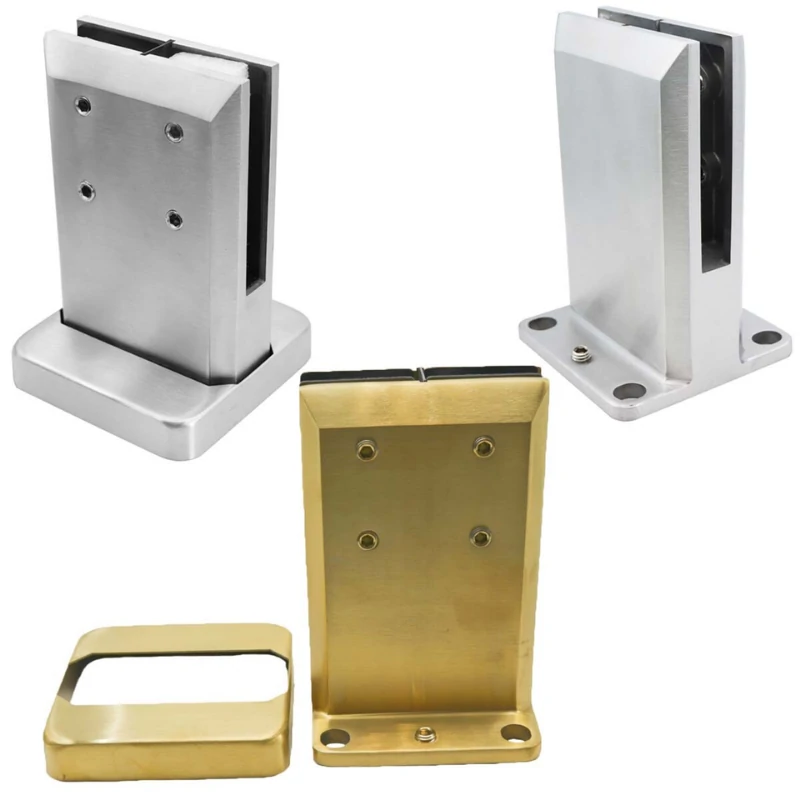

Double-Sided Glass Spigots: How Shared-Joint Hardware Cuts Pool Fence Core Drilling by 40%
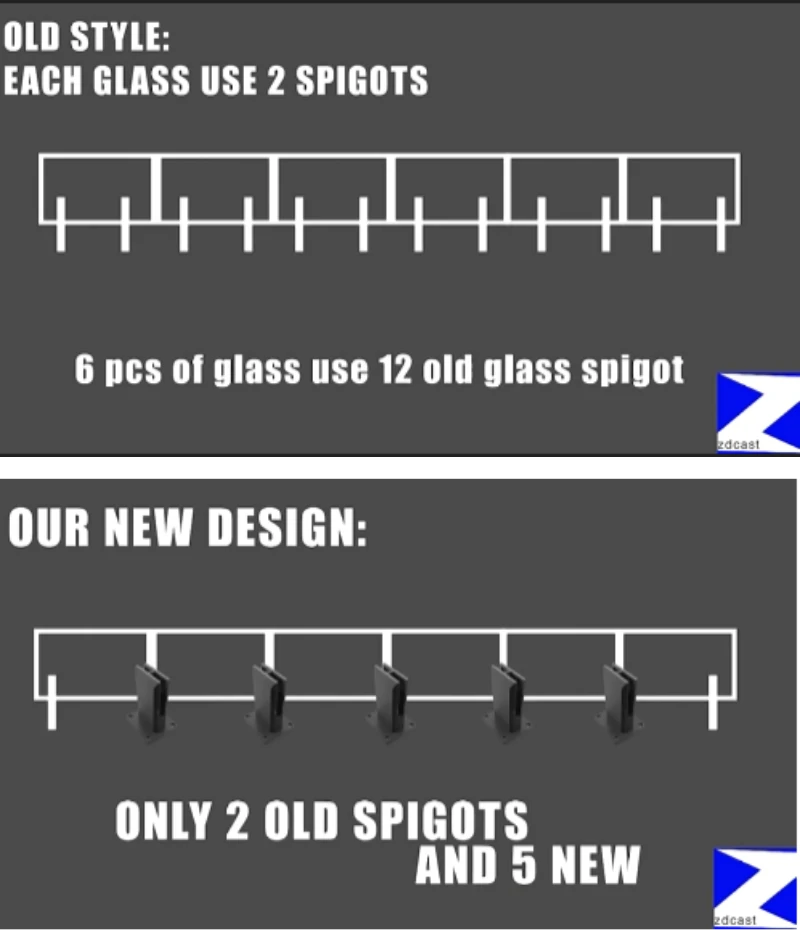
In conventional frameless glass pool fencing, every single glass panel stands on two dedicated spigots. On a standard 6-panel residential run, that means 12 individual castings to purchase, 12 core-drilled holes in expensive concrete or tiles, and 12 baseline heights to level. The Double-Sided Glass Spigot re-engineers this layout by placing one heavy-duty shared spigot at the junction between two adjacent panels. By moving from two fittings per panel to one joint-shared fitting plus end supports, contractors cut total hardware pieces and concrete core drilling by over 40% without sacrificing lateral load strength.
1. The Math of Shared Spigots: From 12 Down to 7
When each glass sheet requires two independent spigots, the hardware count scales strictly as 2 × N. With an in-line double-sided spigot bridging the vertical seam between adjacent panels, each intermediate joint shares a single foundation anchor. The hardware formula becomes N + 1:
|
Run Length |
Traditional 2-Per-Panel |
ZDCAST Shared System |
Hardware & Core Drilling Saved |
|
2 Glass Panels |
4 standard spigots |
3 spigots (2 end + 1 double-sided) |
1 spigot (25% reduction) |
|
4 Glass Panels |
8 standard spigots |
5 spigots (2 end + 3 double-sided) |
3 spigots (37.5% reduction) |
|
6 Glass Panels |
12 standard spigots |
7 spigots (2 end + 5 double-sided) |
5 spigots (over 41% reduction) |
|
10 Glass Panels |
20 standard spigots |
11 spigots (2 end + 9 double-sided) |
9 spigots (45% reduction) |
For a fencing contractor or installer, the primary savings are not just the bill of materials — they are jobsite hours:
- 40% Fewer Core-Drilled Holes:Fewer penetrations into concrete slabs, stone copings, or timber sub-framing, dramatically reducing drill rig setup time and diamond-tip core bit wear.
- Automatic In-Plane Alignment:Clamping both glass edges inside one shared, precision-machined fitting forces both panels onto the exact same vertical plane, eliminating step-offs between adjacent sheets.
- Lower Shipping Freight:Reducing overall hardware count on a 100-meter commercial project by dozens of heavy stainless castings significantly lowers pallet shipping weight.
2. Two Components for a Complete Perimeter: 180° In-Line & 90° Corner
A typical perimeter is rarely a straight line; pool enclosures and terrace perimeters require clean, rigid corner turns. The ZDCAST double-sided system pairs two dedicated castings:
- 180° In-Line Double-Sided Spigot:Positioned at the seam between two linear glass sheets. It features two independent clamping pockets separated by an engineered central divider, securing both panels with four heavy-duty grub screws.
- 90° Dedicated Corner Glass Spigot:Specifically cast to lock perpendicular glass panels at right angles. Traditional layouts crowd two standard spigots close together at a corner, creating awkward base overlaps and cleaning traps. A dedicated 90° spigot anchors both panels into one structural base, forming a rigid corner box.
3. Engineering Details: Friction Clamping, Leveling, and Coastal Alloys
Sharing a spigot between two panels means the fitting carries load from both sides. To deliver reliable structural stability in exposed outdoor and coastal environments, the hardware incorporates several critical engineering features:
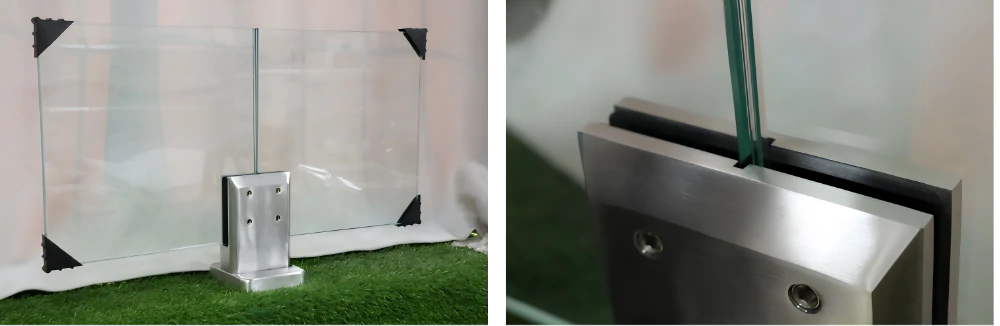
- Zero Glass Drilling (Friction Grip):High-tensile stainless clamping screws apply uniform pressure across industrial EPDM elastomer protection gaskets. The glass requires no pre-drilled holes or waterjet cutouts, eliminating tempering fracture risks and field alignment errors.
- Independent Dual Clamping Zones:Four heavy-duty socket grub screws (two per side) allow installers to tighten or micro-adjust one glass panel without disturbing the hold on the neighboring panel.
- Base Plumb Micro-Adjustment:The base plate integrates perimeter leveling grub screws, allowing installers to level the spigot directly against rough concrete or sloping tiles before torquing down anchor bolts.
- Concealed Snap-On Dress Ring:A low-profile, matching stainless steel dress ring snaps over the base plate, concealing all concrete anchor bolt heads for a seamless, tamper-resistant finish.
- Duplex 2205 Marine Alloy:Cast in Duplex 2205 stainless steel, providing twice the yield strength of 304/316 and proven resistance to chlorinated pool splash and salt air spray.
4. Technical Specifications & Load Guidelines
|
Parameter |
Specification |
|
Product System |
Patented Double-Sided Glass Spigot & Dedicated 90° Corner Clamp System |
|
Core Components |
180° In-Line Double-Sided Spigot (intermediate) + 90° Dedicated Corner Clamp |
|
Compatible Glass Thickness |
10 mm – 14 mm (3/8″ – 9/16″) tempered and laminated glass |
|
Material Grade |
Premium Duplex 2205 (PREN ≈ 34) or Marine-Grade 316 Stainless Steel |
|
Clamping Arrangement |
Independent dual-side friction clamping; 4 heavy-duty hex grub screws per unit |
|
Glass Preparation |
Hole-free friction clamping — no pre-drilled holes required in glass |
|
Base Leveling & Alignment |
Perimeter leveling grub screws for fine-tuning base plumb on uneven substrates |
|
Flange Cover |
Matching snap-on stainless steel dress ring (fully conceals concrete anchor bolts) |
|
Available Finishes |
Satin Brushed, Mirror Polished, PVD Titanium Gold / Brass, Matte Black |
|
Standard Inclusions |
Cast body, heavy-duty EPDM protection gaskets, snap-on base dress ring, anchors |
Because shared-joint spigots carry tributary load from two panels, panel span and wind exposure must be verified. For high-wind zones or heavy commercial traffic, glass panel width and glass thickness (12 mm recommended over 10 mm) should be engineered to match local building codes.
5. Installation Sequence on Site
- Layout and Core Drilling:Mark anchor points along the perimeter layout line. Drill one hole per joint rather than two, utilizing slotted base holes for alignment tolerance.
- Base Leveling:Anchor the base loosely, adjust the perimeter leveling screws until the clamp body is plumb in both axes, then torque down the anchor fasteners.
- Insert Gaskets & Position Panels:Seat the EPDM gaskets into both clamp pockets. Lower the first glass panel into position, then align and slide in the adjacent panel.
- Torque Clamping Bolts:Progressively torque the four clamping grub screws to the specified torque rating. Check panel vertical alignment and handrail gap consistency.
- Snap on Flange Cover:Slide and snap the stainless steel dress ring over the base plate to conceal mounting anchors.
6. Frequently Asked Questions
Can double-sided spigots be used on 12 mm tempered glass?
Yes. The clamping channel and heavy-duty EPDM gasket set are engineered for 10 mm to 14 mm (3/8″ to 9/16″) monolithic tempered or laminated glass panels.
Do the glass panels need holes or cutouts?
No. The system uses high-strength friction clamping with industrial EPDM gaskets. Panels can be ordered as standard rectangular cut-and-tempered sheets without custom drilling.
What happens if one glass panel breaks?
Because the clamping screws operate independently on both sides of the central divider, one panel can be safely loosened and replaced without removing the spigot or disturbing the adjacent standing glass.
Is 2205 duplex necessary, or is 316 sufficient?
For inland pools and sheltered residential balustrades, marine-grade 316 performs well. For pools situated within 1 km of the ocean, salt-chlorinated pools, or public commercial facilities, Duplex 2205 is strongly recommended to prevent pitting and tea-staining.
7. Request Specification Drawings & Trial Samples
Whether you are planning a high-end coastal pool perimeter or bidding on a multi-unit residential development, switching to ZDCAST double-sided glass spigots directly lowers jobsite labor and hardware costs. We cast, machine, polish, and coat in-house, with spectrometer heat verification and material test certificates provided with every export shipment.